
Puppy and Dog Advice
SCOTT VETERINARY CLINIC LTD*Is your dog’s vaccination due?*
Vaccinations
Vaccinations are recommended for your pets to help protect them against potentially life threatening diseases such as:
- Canine Distemper
- Viral Hepatitis
- Parvovirus
- Adenovirus
- Leptospirosis canicola/icterohaemorrhagiae
- Parainfluenza Virus/Bordetella Bronchiseptica
Puppies should receive their first vaccination as soon as possible after 7 weeks then the 2nd at 10 weeks (minimum 2 weeks later). Booster vaccinations are then required at intervals as explained by your vet.
It is essential to make sure that your dog is fully protected and most kennels insist upon full vaccination before any dog is admitted.
All vaccinated dogs are invited to attend a free 6 month health check up with one of our nurses. This health check will monitor your pets weight and general health. The nurse will also discuss preventative health issues such as worming and flea treatment and diet and exercise.

See our Pet Health Plans
Junior Club
After your puppy’s 2nd vaccination with us, you are invited to attend “Junior Club” nurse consultations. These consultations are offered free of charge to clients, at 4 stages throughout your puppy’s development.
Junior Club 1st- A 30 minute consultation, usually 4 weeks after 2nd vaccination, at approximately 16 weeks old. The nurse will discuss diet, exercise, dental health, a worming plan and flea treatment. Your pets weight will be recorded.
Junior Club 2nd – A 15 minute consultation, usually 4 weeks after 1st Junior Club at approximately 20 weeks old. The nurse will discuss your pets progress, worming plan and records your pets weight.
Junior Club 3rd – A 15 minute consultation, usually 4 weeks after 2nd Junior Club at approximately 24 weeks old. The nurse will discuss your pets progress , worming plan, record your pets weight and discuss the benefits of neutering.
Junior Club 4th – A 15 minute consultation, usually at 9 months. The nurse will discuss an appropriate long term worming and flea treatment protocol, post neutering weight check ( if appropriate ) and answer any other questions you may have.
You will also be issued with a 20% off voucher to spend on one item of any waiting room retail, within one month of this appointment, this excludes any already discounted items.
Dog Microchipping in Bedford
Dog microchipping can be beneficial because the microchip can be read by a special scanner and that means that your pet is permanently identified. If your dog escapes from the garden and is brought to us or any of the other rescue charities then he/she can quickly be returned to you.
It is a legal requirement for you to have your dog microchipped or you could face a large fine.
Puppy Health Checks
The Practice offers a free puppy check. This consultation is with one of our vets. This is a good opportunity to get advice on how to care for your new puppy.
This consultation is for puppies usually less then 12 weeks old, before first vaccination.
Puppy Parties
Read more about our Puppy Parties here
Parvovirus
This virus causes a rapidly fatal disease. The symptoms are diarrhoea, vomiting and marked dehydration. Puppies in particular can die within a few days due to rapid fluid loss. It tends to affect black and tan breeds more than other breeds.
Thanks to vaccinations, parvovirus is now a disease we do not see that often but when it does appear we are still limited in our success with treatment.
Claw Clipping in Dogs
Neutering (Spay/Castrate)
Routine Neutering
Female dogs: Ovariohysterectomy (also known as Spay or neutering) involves the surgical removal of both ovaries and the uterus.
Spaying prevents the risk of unplanned pregnancies but also prevents medical problems such as false pregnancy (where the bitch behaves as though she has a litter and even produces milk) and an infected womb, called pyometra, the latter can be fatal.
Spaying also reduces the risk of diabetes and mammary tumours. Bitches are usually spayed after their first season. In some breeds we recommend delaying spaying until they are a little older. Please discuss this with your vet.
Male dogs: Castration (also known as neutering) is the surgical removal of both testicles. Castration can help reduce social problems such as marking territory, roaming and some forms of aggression or anti-social behaviour.
It can also help reduce the risk of testicular cancer and enlargement of the prostate gland. If one or both testicles have not descended from the abdomen into the scrotum, then the risk of testicular cancer is much higher and we would strongly recommend castration in these cases.
We carry out routine castrations from approximately 6 months of age depending on the size, breed and character of dog.
Laparoscopic (keyhole) neutering in female dogs
From September 2025: A keyhole spay is a minimally invasive surgery where a female dogs ovaries are removed through 2-3 small incisions rather than one larger incision generally used in a standard open surgical spay procedure (where the uterus is also usually removed).
The procedure uses specialised instruments and a camera to visualise the abdominal cavity and removes the ovaries, leaving the uterus intact.
Advantages: Due to the minimally invasive small incisions required with a laparoscopic spay, dogs can usually return to normal exercise after 5-7 days, once they have received a post-operative check by one of our clinical team.
The smaller incisions usually result in a reduction of any post operative pai or discomfort aiding a smooth and positive recovery and there are generally fewer post operative complications are reported following a laparoscopic spay, such as wound infection or breakdown.
Candidates: Eligible patients must be between 8kg-30kg in weight (they must not be overweight). Existing neutering guidelines remain the same – ideal time to spay is 12 weeks from the beginning of the last season (some breed specific timings may apply).
Cost: We use specialised equipment and expertise to carry out laparoscopic surgery and this will usually incur an increased cost compared to a standard open spay procedure. The surgery will be carried out by 2 of our experienced senior veterinary surgeons.
Laparoscopic Spay FAQ’s
Can every female dog have a laparoscopic spay? For very small dogs there may not be enough room in the abdomen for our spay keyhole instruments and camera, therefore we only offer this procedure to dogs over 8kg.
It is also not recommended for overweight dogs.
Why is a laparoscopic spay more expensive than a standard spay? Due to the specialised equipment and expertise of our veterinary team a laparoscopic spay will incur an increased cost compared to a standard open spay procedure.
Is it ok to only remove the dogs ovaries and not the uterus? Simple removal of the ovaries is much less traumatic than combined removal of the ovaries and the uterus.
Diseases of the uterus, including infection and cancer, are mainly due to the production of the female hormone oestrogen. Oestrogen is produced by the ovaries, so as long as these are removed, the risk of diseases of the uterus are very small.
How to book: Please call our team on 01234 261622 to arrange a pre-operative health check with one of our vets. This appointment is usually free of charge when associated with a surgery booking. Please ask at the time of booking.
Adenovirus
There are 2 types of adenovirus, one contributes to kennel cough and the other causes canine viral hepatitis. The latter form attacks the liver producing diarrhoea, vomiting, a painful belly and often death. Vaccination protects well against both types of adenovirus.
Parainfluenza
This is another virus which forms part of kennel cough. Viral infection can cause anything from a mild to a deep hacking cough, sometimes persisting for weeks. Occasionally infection can also lead to pneumonia.
The yearly booster does not necessarily include parainfluenza. If you require protection against kennel cough, please discuss this with your vet.
Leptospirosis
This bacterial disease is carried commonly by rats and found in river water. It causes Weil’s disease in humans and can be passed from dogs to us. In dogs Leptospirosis normally presents as acute kidney failure or sometimes as a severe anaemia.
The symptoms are collapse, fever, vomiting jaundice and diarrhoea.
Canine Distemper
Canine Distemper is caused by a herpes virus. It is one of the agents causing kennel cough and it can also cause severe diarrhoea and vomiting often with pus-like discharges from the eyes and nose.
Brain damage and fitting can occur and the disease is often fatal. Vaccination has fortunately made this disease quite rare.
Kennel Cough (Bordetella Bronchiseptica)
Whether it’s the UK or abroad and whether you take your pet with you or not, your holidays this year may impact on your pets. We advise you plan ahead for kennel/cattery stays, to ensure your pets’ vaccinations are adequate and in date.
In dogs, Bordetella Bronchiseptica and Parainfluenza (also known as Kennel Cough) are responsible for this highly infectious and easily spread disease.
It is spread amongst dogs, especially where there are many dogs in one place such as in kennels or at dog shows, even at the park or in your own back garden!
Kennel cough is spread easily from dog to dog. Each cough produces minute droplets containing the bacterium and virus. Once in the air the droplets are inhaled by the next dog and so the infection is passed on.
The incubation period for Kennel Cough is approximately 10 days however, the disease can still be spread for a number of weeks after the infected animal has stopped coughing.
By vaccinating against Bordetella and Parainfuenza (Kennel Cough), you will help your dog avoid sneezing, coughing, painful retching and as a result sometimes vomiting, reduced appetite and nasal discharge. Severe Kennel Cough in puppies or older dogs could cause pneumonia if left untreated and in some cases this could be fatal.
When vaccinating your dog against Kennel Cough we recommend you also note the following:
• Your dog is not fully protected from Bordetella until 72 hours after the KC booster vaccine has been given.
• Always check with your kennels first as some may have restrictions and may request e.g. a six week period after the vaccine has been given, before allowing them in.
• Kennel Cough vaccinated dogs can shed the vaccine strain of Kennel Cough for several weeks. Some studies show up to 6 weeks. (Kennel Cough is a live vaccine). Immunocompromised individuals can be at risk e.g. pregnant or on chemotherapy.
Is Your Dog Imported from Outside the UK?
Is Your Dog Imported from Outside the UK?
Has your dog bred with a dog that has spent time outside the UK?
Did either of your dog’s parents spend time outside the UK?
If you have answered ‘YES’ to any of these Questions, please download more information here
Worming
We recommend that all puppies are wormed every month until they are 6 months old. Puppies are sometimes born with a large number of worm larvae and these can cause serious problems as they mature into adult worms.
Dogs from the age of 6 months should then be wormed every 3 months throughout their life. Not only is it beneficial to the dog to have no worms, but it is also the duty of every responsible dog owner to reduce the risk to human health from the worm larvae.
We advise using worming products available from us.
Feeding
Puppies should be fed a complete puppy food from weaning to the age of 6 months. After this a dog should receive a complete adult dog food. There are special dietary considerations for older or overweight dogs and large breed puppies. It is advisable to gradually introduce new foods to avoid stomach upsets.
We sell a selection of life stage diets in our waiting room. You can also order pet food using our online shop facility.
Please contact the surgery for more information. You can arrange to speak to one of our nurses about your dog’s diet.
Flea treatment
We sell a range of different flea products. Please ask us for advice about Fleas.
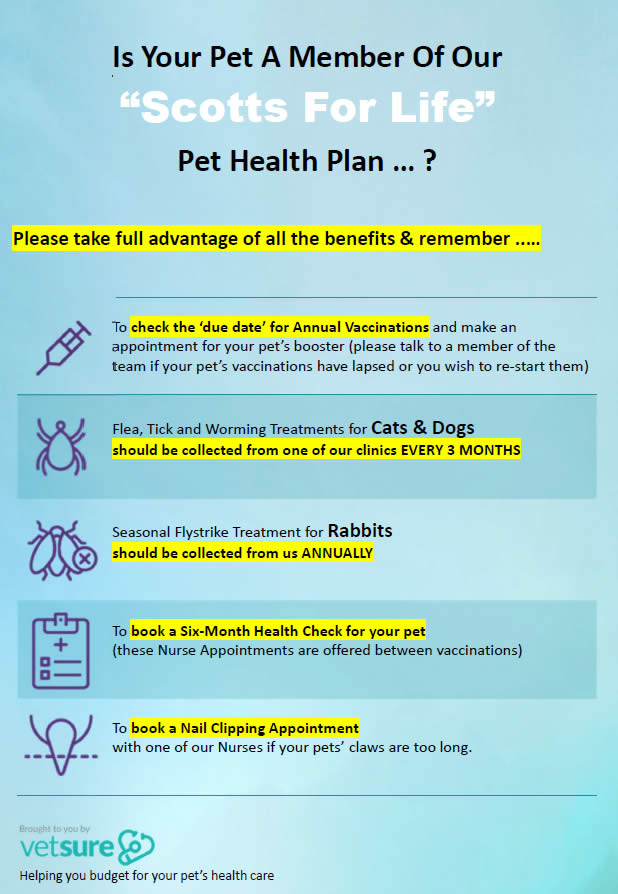
Do you know all the benefits of our Pet Health Plan?
XL Bully guidance for owners
Client Testimonials
Scott Veterinary Clinic Ltd


